Paris or Rome for Your Next European Story
Paris or Rome? Compare neighbourhood rhythms, food, fashion and ancient stories to choose the European city that best fits your next slow-paced escape.
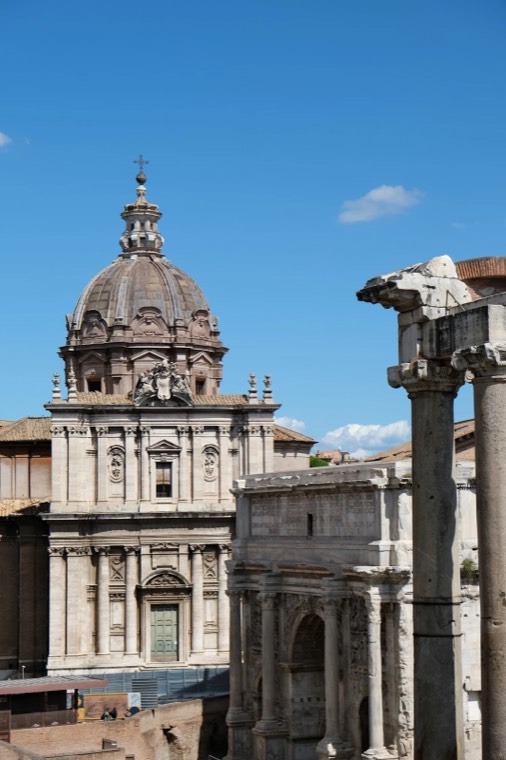
At the north-western end of the Roman Forum, the Curia Julia still carries the sober proportions of a working senate house. Its brick exterior can seem almost restrained beside the nearby Arch of Septimius Severus, but that contrast is precisely where Roman archaeology becomes most compelling. This was not a city arranged for postcard views. It was a densely used civic stage, repaired, rebuilt, commemorated and argued over for more than a millennium.
For a visitor, the Forum can initially feel like a field of handsome fragments: columns without roofs, marble bases without statues, pathways that appear to lead nowhere. Read carefully, however, and each layer begins to reveal a decision. A temple was moved to make room for political theatre. An arch announced military victory at the edge of the city’s most important public square. A church rose within the shell of an earlier building, preserving one Rome while transforming another.
The Forum is often approached as a checklist between the Colosseum and the Capitoline Hill. That is understandable, particularly on a short stay, yet it misses what makes the site so affecting. Archaeology here is less about locating a single perfect ruin than learning to notice how a place has been edited over time.
Stand near the Arch of Septimius Severus and look south along the Via Sacra, the Sacred Way. Triumphal processions once passed through this route, carrying generals, captives, spoils and the expectations of the crowd. The road beneath your feet is not simply Roman in the neat sense many visitors imagine. Its surface, route and surrounding buildings changed across centuries. What survives is a palimpsest, with imperial Rome, late antiquity and medieval Rome all written over one another.
This is why the Forum rewards an unhurried visit. A guide can point out a threshold, an inscription or a reused block of stone, but the pleasure lies in pausing long enough to ask a simple question: what did this space ask people to believe?
Julius Caesar began the Curia Julia as part of his remaking of the Forum, and Augustus completed it after Caesar’s death. The building replaced an older senate house and was more than a practical upgrade. It formed part of a calculated reshaping of Rome’s political centre, placing the story of republican government within a new era of concentrated power.
Inside, senators sat in ranks facing a central aisle. The room’s scale is surprisingly intimate when set against the grand rhetoric of empire. Decisions that affected provinces from Britain to Syria were debated in a chamber that asks for attention rather than spectacle.
Its survival also tells a later story. The Curia became the church of Sant’Adriano in the seventh century, a conversion that helped preserve much of its structure. Roman archaeology is full of such bargains. A building endures not because it was left untouched, but because a later generation found another use for it. Purity is rarely the point in Rome. Continuity, adaptation and sometimes plain practicality matter more.
The Forum was once crowded with bronze and marble figures, honouring emperors, senators, generals and gods. Most have gone, melted down, removed or broken apart. Yet their empty bases remain. These plinths are not decorative leftovers. They show how public memory was managed.
To erect a statue in the Forum was to claim visibility in the heart of civic life. To remove one could be an equally forceful act. Emperors who fell from favour might be subjected to damnatio memoriae, their names chipped away and their images altered or destroyed. The gaps are evidence too. Archaeology does not only reconstruct what was present; it also pays close attention to what was deliberately made absent.
It is tempting to picture ancient Rome as a clean procession of white marble monuments. In reality, the Forum had the noise and friction of a busy urban centre. Legal cases were heard, commercial exchanges took place, priests performed rituals, candidates courted voters and crowds gathered for announcements. Smoke from sacrifices, dust from sandals and animals, the sharp scent of food stalls and the press of bodies all belonged to the scene.
The Basilica Aemilia, on the north side of the Forum, helps restore some of that ordinary intensity. Despite its modern name, a Roman basilica was not a church but a large covered public building. It offered space for business and legal affairs, as well as a degree of shelter from Rome’s hard summer light and winter rain. Look for the green and white marble fragments and the traces of its long footprint. The grandeur mattered, certainly, but so did usefulness.
This is one of the most useful corrections Roman archaeology offers. Monumentality and daily life were not separate categories. A temple could be sacred, political and socially practical at once. A paved square could host ceremonial triumphs one day and routine encounters the next.
A thoughtful Forum visit does not require an archaeology degree, though a little preparation changes the experience. Begin by choosing one line of sight rather than trying to absorb everything at once. From the Temple of Saturn, look towards the Capitoline Hill and consider why Rome’s treasury was kept so close to the city’s religious and political core. From the Temple of Antoninus and Faustina, notice the later church of San Lorenzo in Miranda built into its porch. The classical columns and Christian façade are not rivals. They are a record of Rome’s long habit of building with what it inherits.
Then look down as often as you look up. Changes in paving, drains, steps and levels can reveal more than a distant roofline. Rome’s ground level rose over time as buildings collapsed, were buried, were repurposed and made way for new construction. The famous ruins sit below parts of the modern city because centuries of life accumulated above them.
Finally, allow uncertainty to remain. Archaeologists work with inscriptions, ancient texts, soil layers, building techniques and material finds, but not every question has a settled answer. Labels can sound definitive when the evidence is more delicate. A good reading of the Forum leaves room for debate rather than pretending every stone has one tidy explanation.
The strongest moments in the Forum are rarely the grandest. They may be a worn flight of steps near the Temple of Castor and Pollux, or a patch of brickwork that reveals a repair made centuries after the original structure. These details bring the ancient city closer because they show human choices: someone paid for that restoration, altered that doorway, reused that marble, or wanted a name remembered.
For travellers who prefer stories to spectacle alone, the Forum is an invitation to see Rome as a city that has never stopped revising itself. On Rêverie Tours’ Rome mythology walk through the Imperial Forums, myths and monuments can be read side by side, revealing how rulers used divine ancestry, heroic tales and public architecture to make authority feel inevitable.
Leave the Forum with one image held clearly in mind rather than a hundred photographs competing for attention. It might be the severe doorway of the Curia, the reliefs curling around a triumphal arch, or the unlikely marriage of a Roman temple and a medieval church. That is often enough to make the stones speak again.
Join our Rome Mythology Tour: two hours among the Imperial Forums, from Romulus and Remus to Trajan, €65 per person.
See the Rome Mythology Tour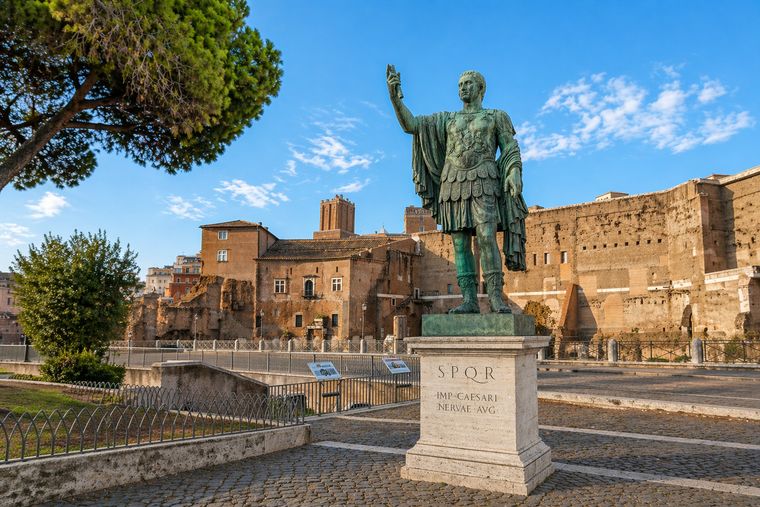
Paris or Rome? Compare neighbourhood rhythms, food, fashion and ancient stories to choose the European city that best fits your next slow-paced escape.
Learn how to navigate Roman forums with a thoughtful route, timed pauses and myth-rich context, from the Arch of Titus to Trajan’s Market in Rome today.