French Market Etiquette Guide for Paris Mornings
A French market etiquette guide for Paris, with graceful advice on greetings, produce, cheese and pacing your visit to Marché d’Aligre with calm assurance.
Begin at the stone façade of Saint-Germain-des-Prés church, before the pavement tables have filled and the neighbourhood has begun performing its most familiar version of itself. To understand how to explore Saint Germain, resist the urge to treat it as a single postcard of cafés and expensive shopfronts. This small left-bank quarter is better read in layers: medieval foundations, existentialist arguments, publishers’ tables, butter-yellow patisserie windows and the particular pleasure of choosing one beautiful thing to take home.
Saint-Germain-des-Prés is compact enough to walk without a plan, but it rewards a little intention. Give it a morning or a long afternoon rather than trying to absorb it between the Louvre and the Eiffel Tower. The aim is not to collect addresses. It is to notice how literature, faith, food and fashion continue to share the same few streets.
The church of Saint-Germain-des-Prés is one of Paris’s oldest. Its Romanesque bell tower has watched the neighbourhood reinvent itself repeatedly, from a powerful medieval abbey to an intellectual address and a polished shopping district. Step inside first. The cool, painted interior offers a useful counterpoint to the bright, busy boulevard outside, and gives the area its original centre of gravity.
From here, stand on Place Saint-Germain-des-Prés and look towards Boulevard Saint-Germain. Café de Flore and Les Deux Magots sit nearby, forever associated with Jean-Paul Sartre, Simone de Beauvoir and the post-war writers and artists who made the Left Bank synonymous with argument. They are worth seeing, especially if it is your first visit, but choose your moment wisely.
A coffee at one of these terraces can be lovely when you want the ritual, the view and the sense of occasion. It is less compelling if you are hungry, short on time or hoping for a quiet local breakfast. Prices reflect the address, and the tables are often filled with visitors photographing the same scene. Have an espresso, linger over the architecture and move on. Saint-Germain’s real charm begins a block or two away.
Walk down Rue de Buci, where the mood loosens. Florists, cheese shops, wine merchants and market stalls bring a more everyday rhythm to the quarter. This is a fine place to buy fruit for later, choose a wedge of Comté, or simply watch the choreography of locals collecting bread and visitors deciding between raspberries and madeleines.
The street can be crowded around lunchtime, particularly in warmer months. If you prefer its village-like quality, arrive before 10 am or return in the early evening when the market bustle gives way to aperitif hour. Keep an eye on the smaller side streets, where courtyards, old signs and restrained façades interrupt the retail theatre of the main thoroughfare.
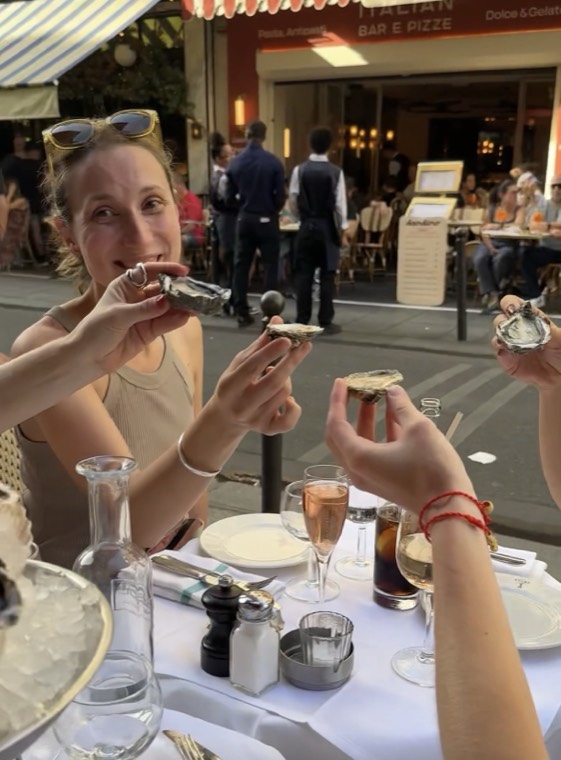
This is also where food should be approached with appetite rather than a rigid checklist. Saint-Germain is a wonderful place for an oyster and a glass of white wine, particularly if you enjoy the small ceremony of it: a chilled platter, briny shells, rye bread and butter, a few drops of lemon if you like. Oysters suit the neighbourhood’s sensibility - elegant but unfussy, provided you choose a place that feels busy for the right reasons rather than merely conspicuous.
For lunch, decide what you want from the meal. A proper sit-down meal will take time and should. A simpler counter lunch or a bakery picnic leaves room for galleries and bookshops. There is no virtue in ordering a three-course lunch when you would rather be walking. Paris is most enjoyable when the day has a little space around it.
To explore Saint Germain properly, make room for its literary life. The neighbourhood is inseparable from the book trade, not because every visitor must arrive with a Sartre novel in hand, but because ideas have long been part of the local atmosphere. Publishers, booksellers, students and writers shaped the streets around the abbey, and the habit of reading in public still feels entirely natural here.
Browse a bookshop even if you cannot read French. Look for illustrated editions, exhibition catalogues, French fashion titles or a slim volume of poetry to slip into your bag. A book is a more personal souvenir than a generic Eiffel Tower trinket, and it will keep the texture of the trip alive long after the cheese has been eaten and the photographs have been filed away.
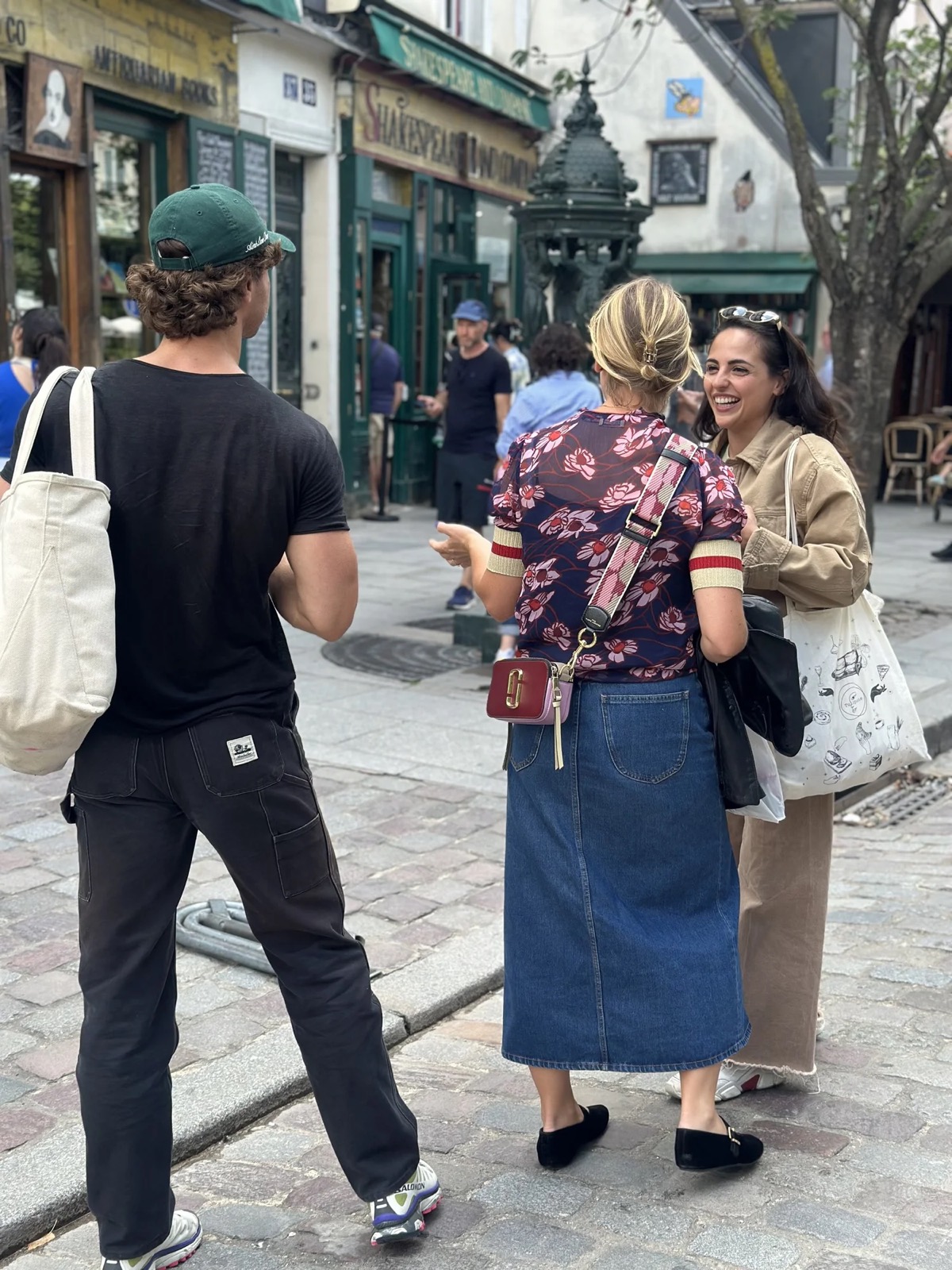
The iconic English-language bookshop Shakespeare and Company is across the river rather than in Saint-Germain itself, so do not force it into this walk just for the name. Saint-Germain has its own bookish personality. The pleasure here lies in following a cover that catches your eye, or noticing which intellectual journals are displayed at the front of a newsagent.
If the history interests you, pause at the statue of Denis Diderot on Boulevard Saint-Germain. He was a central figure of the Enlightenment and co-editor of the Encyclopédie, a vast project devoted to collecting and sharing human knowledge. It is an apt presence in a district where cafés became informal offices for writers, editors and thinkers.
Saint-Germain is not a bargain-shopping quarter, and pretending otherwise leads to disappointment. Its fashion is best enjoyed as a study in taste: clean-lined boutiques, antique jewellery, art books, perfume, silk scarves and objects made to last. The question is not whether you need another purchase. It is whether something carries a trace of the city you actually want to remember.
Rue Jacob and Rue des Saints-Pères are especially good streets for slowing down. Their galleries and design addresses encourage looking rather than rushing. In the windows, you may find contemporary ceramics beside vintage prints, or a perfectly cut coat displayed with the confidence of an artwork. Even for travellers not planning to shop, this is a useful education in the quiet visual codes of the Left Bank.
Vintage lovers should be selective. Some shops cater to a fashion-forward Paris crowd and price accordingly; others require patient rummaging. If your time is limited, a personalised vintage-fashion outing is often more rewarding than wandering blindly. A knowledgeable local can read your style, point you towards the right era and help you distinguish a genuinely special piece from an expensive imitation of one.
Walk towards Place de Furstemberg in the late afternoon. This tiny square, framed by old lamps and tall plane trees, has a hush that feels improbable so close to the boulevard. Eugène Delacroix lived and worked nearby, and the surrounding streets retain an intimate scale that larger Parisian avenues can erase.
This is the moment to put the mobile away. Sit for ten minutes. Notice the changing colour of the limestone, the clipped sound of footsteps, the way a scooter briefly breaks the stillness before the square settles again. If you have bought a book, read a page. If you have bought nothing, all the better: the neighbourhood does not need to be converted into a shopping bag to become yours.
For an evening finish, choose between a glass of Champagne, a small wine bar or an unhurried dinner. Saint-Germain can be glamorous, but it need not be formal. The most memorable meal may be a plate of oysters and a crisp white, followed by a walk back across the Seine with the city lit softly ahead.
Saint-Germain-des-Prés is easy to reach by Métro, with Saint-Germain-des-Prés and Mabillon the most useful stops. Wear shoes suited to cobbles and long pauses on the footpath. The area is generally lively and comfortable to walk in, though its narrow streets can feel congested on weekends.
Sunday has a distinctive mood: quieter in some corners, busier around café terraces and the most recognisable streets. Monday can be less reliable for independent galleries and smaller shops. If shopping and gallery-hopping matter most, plan for Tuesday through Saturday. If atmosphere is the priority, an early weekday morning gives you the rare sensation of the neighbourhood before it becomes an idea of Paris for everyone else.
A small-group cultural walk with Rêverie Tours can add the stories that are easy to miss - the philosophers behind the terrace tables, the artists behind a quiet square, and the food traditions that make an aperitif feel like more than a pause between sights. Still, leave time afterwards to return to the place that caught your attention. Saint-Germain is at its best when a good story leads to your own.
Allow at least three hours for the church, Rue de Buci, a bookshop, a café or oyster stop, and the streets around Place de Furstemberg. A half-day is ideal if you would like lunch, shopping or gallery visits without hurrying.
Yes. It offers a different kind of Paris experience: smaller-scale, literary and sensory rather than monumental. It is particularly rewarding for repeat visitors who want context, food, fashion and streets with a lived-in rhythm.
They are worth it for the setting and cultural history, especially for one coffee or an aperitif. For a leisurely, better-value meal, look a few streets beyond the famous terraces.
Choose something with a point of view: a French art or fashion book, a vintage scarf, an object from an independent maker, or edible gifts from a specialist food shop. The best choice depends on your taste, not on what appears in every souvenir display.
Finish slowly. Find a seat near Place de Furstemberg or along the Seine, order one final glass or dessert if you wish, and let the day settle before you chase the next landmark. That small stretch of unplanned time is often what you remember most clearly.
Join our Paris & the Philosophers Walk: two hours on the Left Bank with Beauvoir, Descartes, Rousseau and Voltaire, €65 per person.
See the Philosophers Walk
A French market etiquette guide for Paris, with graceful advice on greetings, produce, cheese and pacing your visit to Marché d’Aligre with calm assurance.
Plan a Champagne tasting in Paris with confidence: learn what to notice in the glass, which styles to try, and how to savour each pour with a local guide.